Using AI to Draft Legislation
(And Why Someone Wants to Fire Me For It)


There’s a particular irony to being accused of reckless futurism while working on whisky legislation.
Whisky, after all, is an ancient craft. It’s about patience, tradition, and time-tested methods that have been refined over centuries. The basic process hasn’t fundamentally changed since Scottish monks first started distilling spirits in the 1400s. You take grain, water, yeast, and heat. You wait. You age. You respect the process.
And yet here I am, facing a recall petition that specifically cites my support for using artificial intelligence to help draft the Alberta Whisky Act - legislation designed to protect and promote that very tradition.
The accusation? That I’ve “advanced AI-generated legislation without public consultation.”
It’s a charge that sounds alarming if you don’t look closely. But when you understand what we’re actually doing - and why - I think you’ll see something different. Not recklessness, but responsibility. Not abandonment of tradition, but a commitment to preserving it with the best tools available.
Let’s talk about what’s really going on.
The Problem We’re Trying to Solve
Alberta makes world-class whisky.
Our province has everything the great whisky regions have: exceptional grains grown in our unique climate, pristine water sources, skilled craftspeople who understand the art and science of distilling. What we’ve been missing is the legal framework that says to the world: “When you see ‘Alberta Whisky’ on a label, it means something specific. It represents standards. It carries weight.”
Think about what Kentucky did with bourbon. What Scotland achieved with Scotch. What Tennessee built with its whiskey tradition. These aren’t just beverages - they’re billion-dollar industries, cultural ambassadors, sources of regional pride and economic vitality. The legal protections around these products didn’t diminish them. They made them possible.
My colleague, Service Alberta Minister Dale Nally has a mandate to create that framework for Alberta. The Alberta Whisky Act would define production standards, aging requirements, ingredient specifications - all the details that distinguish authentic Alberta whisky from anything else.
This is exactly the kind of legislation our distillers have been asking for.
Keenan Pascal, CEO of Hansen Distillery in Edmonton, told us he’s excited about “Alberta better representing its products internationally.” He noted that an Alberta whisky definition “relates closely to the particular ingredients and environment in the province” and represents “another expansion of the amazing history of whisky making.”
Dr. Jordan Ramey of Calgary’s Burwood Distillery echoed this. Our distillers want to tell Alberta’s whisky story more effectively on the international stage. They want the legal tools to compete with established regions. They want protection from misrepresentation and clear standards they can market.
This is about economic opportunity. Jobs. Global competitiveness. Putting Alberta on the map alongside the world’s recognized whisky regions.
So what’s the problem?
The Challenge of Capacity
Our legislative agenda is packed.
The brilliant legal professionals in our legislative counsel office - the people who actually draft our laws - are overwhelmed with high-priority legislation. Budget legislation. Healthcare reform. Economic development initiatives. The work that touches millions of Albertans’ daily lives.
Drafting legislation is meticulous, technical, difficult work. It requires analyzing regulations from other jurisdictions, ensuring consistency with existing law, anticipating unintended consequences, crafting precise language that will stand up to legal scrutiny. For complex bills, this can take months or even years.
The Alberta Whisky Act isn’t complex in that way. It’s relatively straightforward - defining standards for a specific product category. But “straightforward” doesn’t mean “quick” when you’re working within a system where every minute of expert time is already allocated to higher-stakes priorities.
We could wait. Put it in the queue. Let our distillers wait years for the legal framework they need while the traditional drafting process slowly works through the backlog.
Or we could ask a different question: what if we used modern technology to speed this up?
The AI Solution (And What It Actually Means)
Talking about AI can sometimes feel a little abstract. So let’s walk through what we’re actually doing:
We’re using artificial intelligence to assist in the initial drafting of the Alberta Whisky Act. The AI will analyze existing whisky regulations from around the world - Scottish whisky laws, American bourbon standards, Canadian regulations, Irish whiskey rules. It will process thousands of pages of legal text, identify relevant provisions, understand the patterns and structures that make these regulations effective, and draft initial legislative language based on proven frameworks.
Then - and this is crucial - human experts take over completely.
Alberta’s legislative drafters will review every single clause. Legal experts from Justice Minister Mickey Amery’s team will examine the draft for errors, omissions, inconsistencies, or unintended consequences. The standard Cabinet process remains unchanged: government caucus reviews it, Cabinet reviews it, everything gets signed off by the people who are accountable to voters.
And ultimately, nothing becomes law without being introduced in the Legislature, debated publicly, scrutinized by opposition members, potentially amended through committee hearings, and voted on by elected representatives.
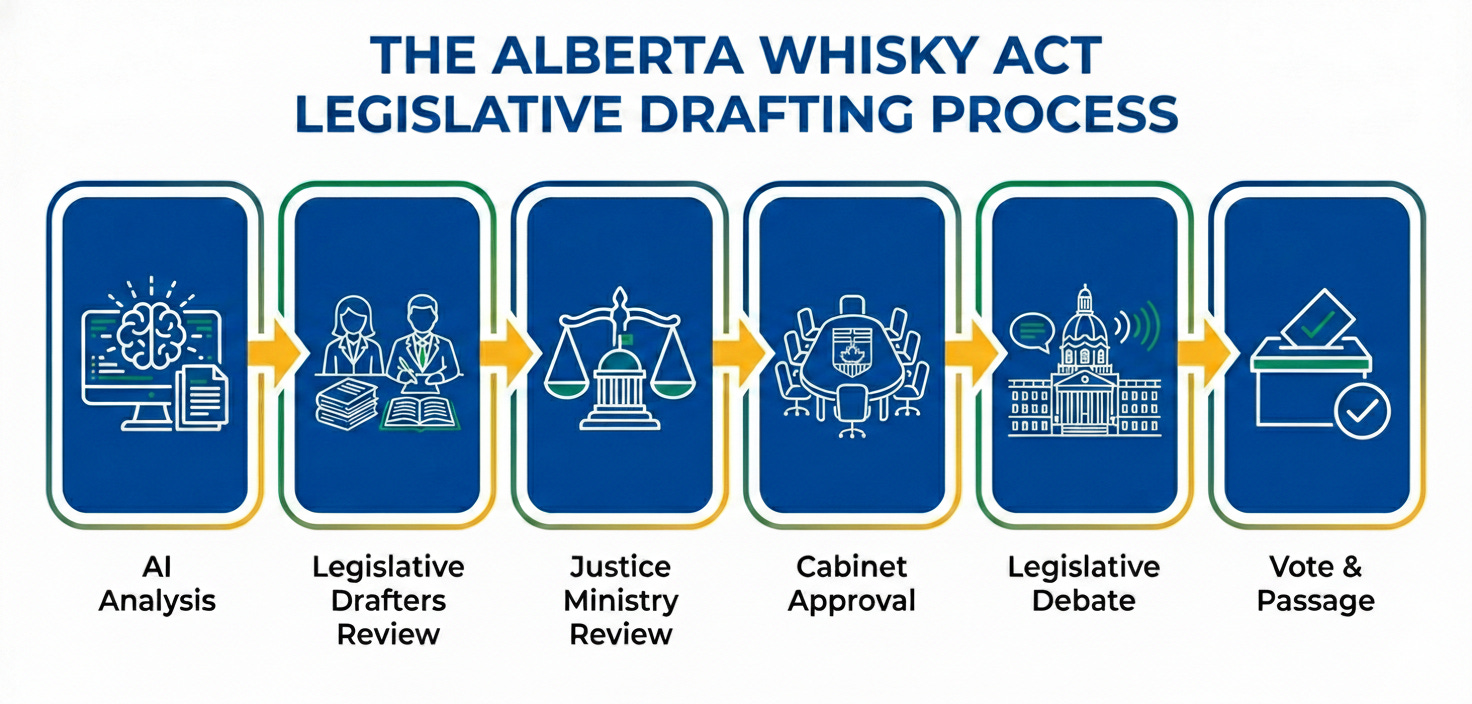
AI doesn’t write our laws. It helps draft the initial text that human experts then shape, refine, verify, and take full responsibility for.
This could reduce legislative development timelines by up to 80 percent. That means Alberta distillers could have the legal protections they need years sooner. That’s years of additional market access, years of economic growth, years of job creation that would otherwise be lost to bureaucratic bottlenecks.
Why Alberta Can Do This Right
We’re not just randomly experimenting with AI in government.
Alberta is home to the Alberta Machine Intelligence Institute, or AMII for short. AMII one of the top AI research centers in the world. We train some of the best and brightest AI experts in the world. We understand both the capabilities and the limitations of these systems.
Randy Goebel, a University of Alberta computing science professor and one of the world’s leading AI researchers, put it bluntly:
“Humans drafting legislation have got it wrong for centuries and the drafting of legislation is tedious, hard work. So, of course, you should use tools that help accelerate the drafting of legislation. To accelerate the creation of accurate legislation is a great goal. Legislators who don’t use AI will be replaced by those who use AI.”
That’s not hype from a tech evangelist. That’s a sober assessment from a serious researcher about the appropriate use of powerful tools.
We checked with every other Canadian province and territory. None of them are using AI to help draft legislation. Alberta will be the first.
Minister Nally chose this whisky legislation specifically because, as he put it, this “doesn’t involve any hearts or lungs.” It’s a low-risk opportunity to evaluate AI capabilities without the high stakes of healthcare or criminal justice legislation. We can learn, we can refine the process, we can identify what works and what doesn’t - all while delivering real value to an industry that needs this framework.
What This Says About Government Innovation
There’s a tendency in politics to treat “innovation” and “tradition” as opposites. To assume that using new tools means abandoning old values. To believe that moving faster must mean moving recklessly.
But that’s not what innovation means.
Innovation in government means using the best available tools to serve the public more effectively. It means being willing to test new approaches in appropriate contexts. It means asking “how can we deliver better results?” rather than defaulting to “we’ve always done it this way.”
The irony of using AI to draft whisky legislation isn’t lost on me. We’re using cutting-edge technology to create legal protections for one of humanity’s oldest crafts. We’re accelerating bureaucratic processes to support an industry built on patience. We’re pioneering new governmental approaches to preserve traditional expertise.
But that’s exactly what responsible innovation looks like. It’s not about replacing human judgment with machines. It’s about augmenting human capabilities so we can accomplish more, faster, without sacrificing quality or accountability.
Think about the distillers themselves. They use modern temperature control systems and precision instruments alongside traditional copper pot stills. They apply scientific understanding of chemistry and biology to a process that predates the scientific method. They blend innovation and tradition because that’s how you make great whisky in the 21st century.
That’s what we’re doing with this legislation.
Addressing the Recall
Which brings me back to where we started: the recall petition.
One of the specific complaints against me is that I’ve “advanced AI-generated legislation without public consultation.”
Let me address that directly.
First: we haven’t generated any legislation yet. We’re in the drafting phase. When we do introduce the Alberta Whisky Act, it will go through the full public legislative process - stakeholder consultation, cabinet approvals, legislative debate, opposition scrutiny, and ultimately votes by elected representatives. There are no shortcuts.
Second: this isn’t about bypassing consultation. It’s about using modern tools to draft legislation more efficiently so we can actually deliver results for Albertans faster. The AI assists with initial drafting. Everything else - the review, the refinement, the approval, the public process - remains exactly as it should be.
The recall petitioner cites this innovation as a reason to remove me from office.
I cite it as proof that we’re a government willing to look to the future instead of being trapped in the past. That we’re committed to using the best available tools to serve the public. That we take economic opportunities for Alberta businesses seriously enough to find better ways of delivering the support they need.
For as long as the residents of Strathcona County entrust me with their votes, I will continue to serve Strathcona-Sherwood Park with that same forward-looking approach.
What This Means for You
If you’re reading this, you probably fall into one of several categories.
Maybe you’re interested in AI and how it’s being applied in the public sector. Maybe you’re curious about government innovation and whether politicians can responsibly adopt new technologies. Maybe you’re following the recall petition process and trying to understand what the real issues are. Maybe you’re a constituent in Strathcona-Sherwood Park looking to better understand my approach to representing our community.
Regardless of which category you’re in, here’s what I want you to understand:
This isn’t about technology for technology’s sake. It’s about solving real problems for real people - in this case, Alberta distillers who need legal tools to compete globally. It’s about finding ways to make government work better without compromising the safeguards that keep government accountable.
The choice isn’t between innovation and caution. It’s between different kinds of caution: the caution that refuses to try anything new because change carries risk, and the caution that carefully pilots new approaches in low-risk contexts where the potential benefits justify thoughtful experimentation.
I believe in the second kind of caution. I believe in testing new tools where it makes sense, learning from the results, and scaling what works. I believe Alberta can be a leader in responsible government innovation precisely because we have the expertise, the institutions, and the democratic safeguards to do it right.
The Alberta Whisky Act will, we hope, soon become law. When it does, it will stand as both a legal framework for a beloved industry and a testament to what’s possible when we’re willing to use modern tools to solve practical problems.
And yes, when that first Alberta Whisky gets poured - aged according to careful standards, protected by thoughtful legislation - there will be something meaningful in that moment.
Not just the product itself, though our distillers deserve recognition for their craft.
But the idea that we can honor tradition and embrace innovation at the same time. That we can use powerful new tools responsibly and transparently. That we can deliver better results for Albertans by being willing to do things differently.”
That seems like a future worth building.
Your Turn
I want to hear what you think.
Does this use of AI in government make sense to you, or does it raise concerns? Do you see this as responsible innovation or reckless experimentation? Are there aspects of this approach you’d want to see changed or additional safeguards you’d want in place?
And what about the broader question: should elected officials be willing to pilot new technologies in government, or should we stick with proven approaches even when they’re slower and more expensive?
Leave your thoughts in the comments. I take the feedback seriously. These conversations help me understand what matters to you and how I can better explain the work we’re doing.
If you found this useful - if you want to stay informed about these kinds of issues as they develop – consider subscribing to my Substack.
I’ll continue writing about the intersection of technology, policy, and governance, with a focus on what’s actually happening in Alberta and why it matters.
Thanks for reading. Our Alberta distillers are building something special. World-class products that deserve world-class recognition. Whether you’re a whisky enthusiast or not, that’s an economic success story worth celebrating and supporting.
Nate Glubish is the MLA for Strathcona-Sherwood Park and a member of Alberta’s Executive Council. The views expressed here are his own.